
Porcelain Costs 5–10× More: Why U.S. Buyers Pay the Premium

Porcelain costs more because every stage of making it costs more: refined kaolin clay, kiln firing at up to 1,400°C, higher breakage rates during production, and hand labor that mass ceramics simply skip. Add historical prestige tied to origins like Jingdezhen, and you get a material where craftsmanship, physics, and reputation all push the price up at once. Brands that hand-produce each piece sit at the far end of that spectrum.
TL;DR:
- Porcelain’s higher cost is driven by the need for pure raw materials, higher firing temperatures, and more skilled labor at each production step.
- Differences among porcelain types, such as hard-paste, soft-paste, and bone china, significantly affect material costs and final quality.
- Elevated raw material prices, including high-purity kaolin from Jingdezhen and specialty glazes, directly influence porcelain’s retail price.
- The labor-intensive firing process and multiple skilled handwork stages increase breakage rates and production costs beyond those of standard ceramics.
- Historical prestige, brand reputation, and handcrafted details like gilding or signatures further inflate the price, especially for collectible or luxury pieces.
Table of Contents
- Why Is Porcelain Expensive? The Core Reasons
- What Makes Porcelain Different From Other Ceramics?
- How Raw Materials Drive the Price of Porcelain
- What Manufacturing Costs Make Porcelain So Labor Intensive?
- Porcelain vs. Ceramic: Is the Extra Cost Worth It?
- Why Do History and Brand Add Even More to the Price?
- How Do You Know If a Porcelain Piece Is Worth the Price?
- Why Myspinshop Believes Handcrafted Porcelain Is Worth the Premium
- Browse Handcrafted Porcelain Made the Traditional Way
- Sources
- FAQ
Why Is Porcelain Expensive? The Core Reasons
The short answer: porcelain demands purer raw materials, hotter and riskier firing, and far more skilled hands per finished piece than earthenware or standard ceramic. Each of those factors compounds rather than stacking neatly, which is why a porcelain vase can cost five or ten times more than a stoneware equivalent that looks similar on a shelf.
Manufacturers don’t choose porcelain because it’s easy to work with. They choose it because customers pay for the result: a denser, whiter, more translucent object that lasts generations if handled with care. That trade off, harder to make but better to own, is the entire story of porcelain pricing, and it shows up at every step from the clay pit to the checkout page.
What Makes Porcelain Different From Other Ceramics?
Porcelain starts with kaolin, a fine white clay that vitrifies into a glass-like, non-porous body when fired correctly. Officially, porcelain is defined by water absorption of 0.5% or less, achieved by firing at temperatures between roughly 1,200°C and 1,400°C, several hundred degrees hotter than most earthenware.
Shoppers often see three labels on porcelain goods, and they’re not interchangeable. Hard-paste porcelain is the classic Chinese formula built from kaolin and feldspar, fired hottest and hardest. Soft-paste porcelain, developed in Europe before true kaolin deposits were found there, fires at lower temperatures and stays slightly softer. Bone china adds bone ash to the mix, giving it exceptional whiteness and translucency at a somewhat gentler firing temperature.
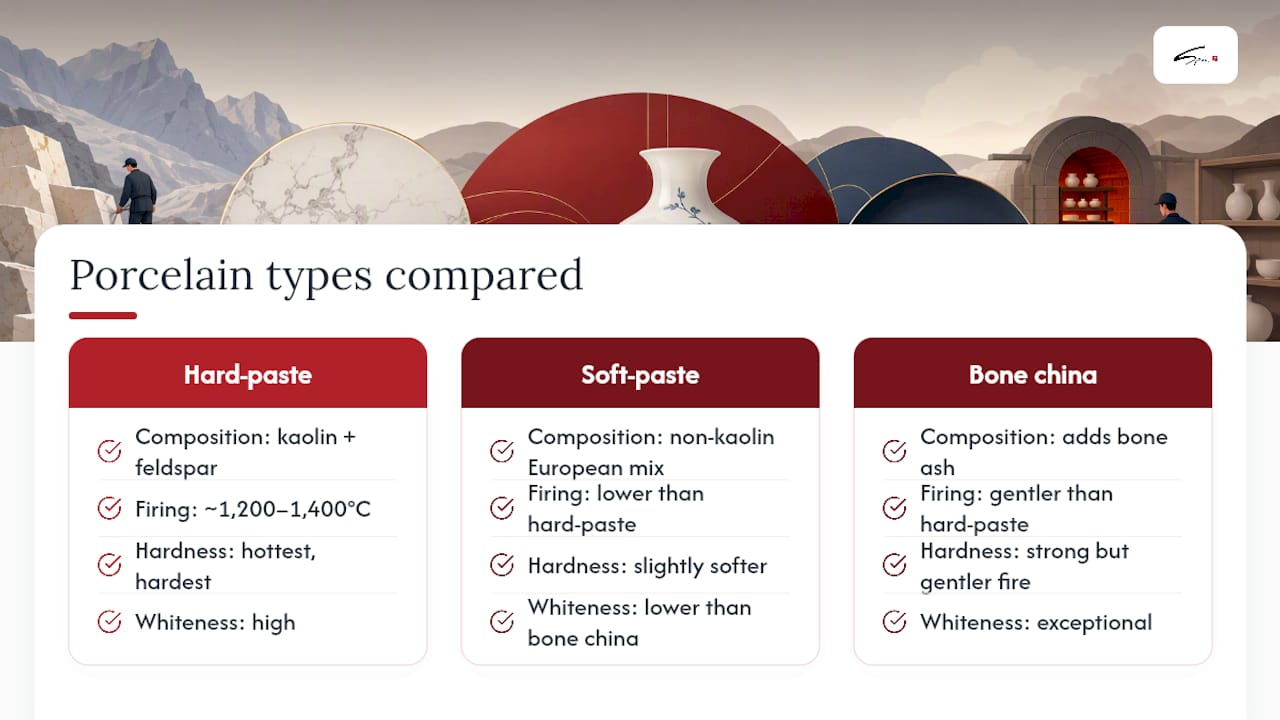
The fineness of the clay particles and how completely the material vitrifies determine whether light passes through a piece and how strong it stays under stress. Getting both right requires tighter quality control than a potter working with coarser stoneware ever needs, and that control isn’t free.
How Raw Materials Drive the Price of Porcelain
Not all kaolin is equal, and that matters more than most buyers realize. High-purity deposits, historically centered around Jingdezhen in China, produce the whiteness and plasticity porcelain needs. Lower-grade kaolin leaves grit, discoloration, or structural weakness that a finished piece can’t hide.
Beyond the clay itself, several inputs push material costs higher before a single hour of labor gets added:
- Feldspar and silica must be blended in precise ratios with kaolin to hit the right vitrification point without warping.
- Specialty glazes, including cobalt, celadon, and copper-red formulas, cost more than standard clear glazes and require exact application to avoid running or crawling in the kiln.
- Metal trims, like gold rims or platinum accents on fine dinnerware, add both material cost and separate low-temperature firing steps.
- Freight and handling for premium clay and glaze materials shipped internationally add a layer of cost that shows up directly in U.S. retail pricing.
None of this is exotic sourcing for its own sake. A studio using inferior kaolin will see more cracked pieces at the kiln door, which means the higher-grade material often pays for itself in fewer losses, even before you count the aesthetic difference.
What Manufacturing Costs Make Porcelain So Labor Intensive?
Porcelain doesn’t go into the kiln once. Most pieces go through a bisque firing to harden the raw clay, a glaze firing to seal and color the surface, and often a third overglaze firing for decorative details like gilding or hand-painted enamel. Each firing consumes energy, takes hours to a full day including cooldown, and carries its own chance of cracking, warping, or discoloring a piece that already survived the previous round.
That risk is the part outsiders underestimate. Porcelain shrinks more than earthenware as it dries and fires, and uneven shrinkage or trapped moisture causes warping that ruins finished pieces at rates well above what lower-fired ceramics experience. Every studio prices its output assuming a percentage of the batch won’t survive, and that loss gets folded into what the surviving pieces sell for.
Then there’s the human labor itself. A porcelain piece typically passes through several skilled hands:
- Throwing or mold-forming the raw shape, which for eggshell-thin porcelain demands far more control than thicker stoneware.
- Trimming and joining parts like handles or spouts before the first firing.
- Hand-painting or hand-carving decorative surfaces, sometimes freehand, sometimes through layered glaze application.
- Quality inspection at multiple stages, catching flaws before they’re baked in permanently.
Pro Tip: Small-batch handcrafted porcelain almost always costs more per piece than factory output, not because the maker is charging a premium for its own sake, but because the same fixed loss rate gets spread across a much smaller run, as explained in detail by British Chains on handcrafted silver costs. A factory that fires 10,000 identical bowls absorbs its breakage differently than a studio firing 40.
Business Insider’s breakdown of porcelain manufacturing points to exactly this combination: the material is genuinely harder to work with, breakage during production runs higher than with everyday ceramics, and skilled labor at nearly every stage adds cost that a machine-stamped mug never incurs.
Porcelain vs. Ceramic: Is the Extra Cost Worth It?
Porcelain isn’t just fired hotter, it performs differently once it’s in your home. Its near-zero water absorption rate compared to standard ceramic tile means less staining, less bacterial growth in food-contact surfaces, and better resistance to chipping over years of use.
On price, the gap is real and measurable. Industry cost guides show porcelain tile running 15% to 40% more per square foot than comparable ceramic, with installation costing more too since porcelain’s density requires specialized cutting tools and more careful handling. Dinnerware and décor follow a similar pattern, with handcrafted porcelain pieces typically priced well above mass-produced stoneware equivalents.
Where does the premium actually pay off?
- High-use kitchenware that sees daily washing and handling benefits from porcelain’s durability and stain resistance.
- Gift and display pieces where translucency and finish quality are the entire point of owning the object.
- Moisture-prone settings, where porcelain’s low absorption prevents the slow degradation cheaper ceramic suffers over time.
Why Do History and Brand Add Even More to the Price?
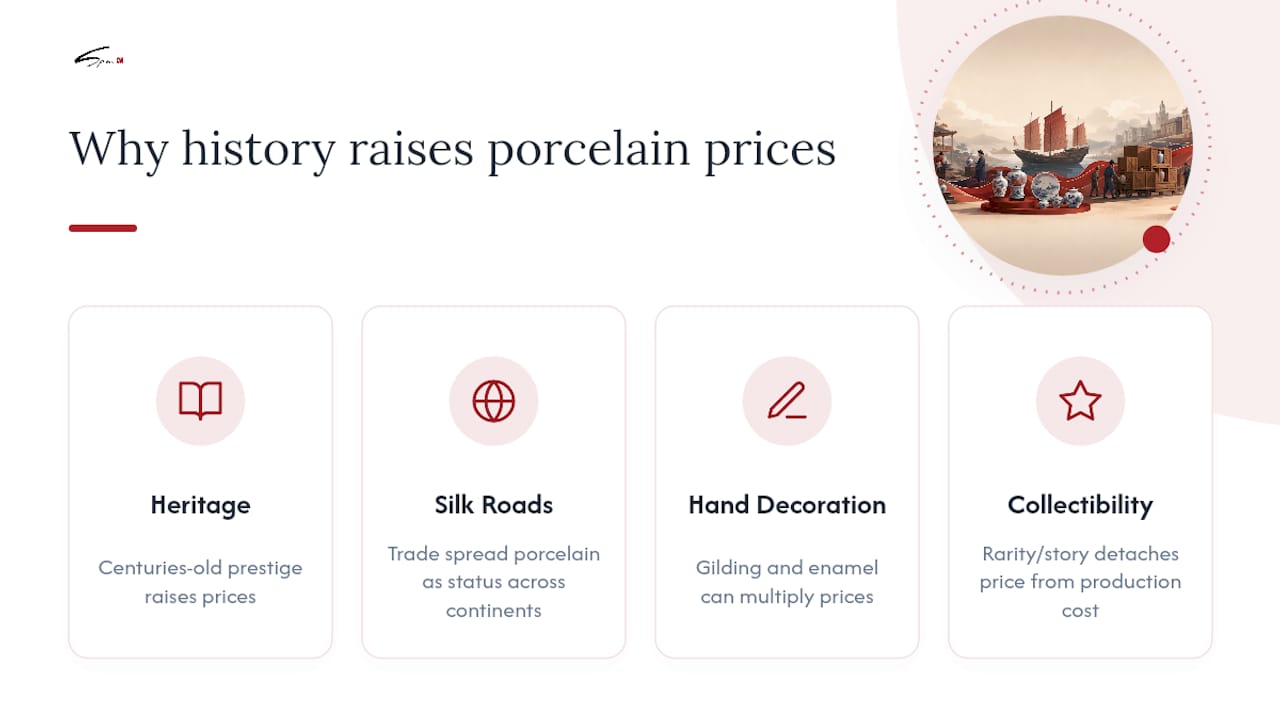
Some of porcelain’s cost has nothing to do with clay or kilns at all. Chinese export porcelain reached Europe as a luxury good centuries ago, and that early scarcity built a prestige association that has never fully faded. Buyers today still pay a premium tied to that history, whether they consciously recognize it or not.
Trade along historic routes documented by UNESCO’s Silk Roads project helped cement porcelain as a marker of status across continents, and that cultural weight still shapes how collectors and gift buyers value a piece. You can trace that lineage in more detail in our history of Chinese porcelain export.
Limited editions, artist signatures, and elaborate hand-decoration compound this further. A piece with gilded rims or hand-enameled scenes can cost several times more than an identical undecorated form, and once a piece becomes collectible, its price stops tracking production cost entirely. At that point you’re paying for rarity and story, which is a different transaction than paying for craftsmanship, though the two often travel together in porcelain valued as an art collectible.
How Do You Know If a Porcelain Piece Is Worth the Price?
Not every expensive porcelain piece deserves its price tag, and not every bargain is a good deal. Here’s how to check before you buy:
- Check the maker’s mark or provenance. A documented origin, whether it’s a historic factory or a named contemporary studio, tells you what you’re actually paying for.
- Hold it up to light. Genuine porcelain shows some translucency at thin edges. If a “porcelain” piece is opaque and heavy, it’s likely earthenware or stoneware mislabeled.
- Inspect the finish closely. Look for even glaze coverage, clean brushwork on hand-painted details, and no visible bubbling or crawling.
- Ask about edition numbers. Limited runs should come with documentation, not just a verbal claim.
- Confirm the return policy. A seller confident in their craftsmanship usually backs it with a reasonable return window.
Pro Tip: Before buying handmade porcelain online, ask the seller for production photos or a maker’s statement. A studio proud of its process will usually share it, and sellers offering small-sample returns are signaling real confidence in what they make.
If you just need durable, attractive tableware for daily use, mass-produced porcelain or even quality stoneware may serve you fine. If you want a piece with character, a documented process, and materials chosen for craftsmanship rather than throughput, that’s where handcrafted production earns its price. You can see that distinction in pieces like our Long Neck Four Brothers Vase, where the hand-finishing is visible in the final form.
Why Myspinshop Believes Handcrafted Porcelain Is Worth the Premium
Myspinshop builds every piece around the same principle this article lays out: quality porcelain costs what it costs because of real material and labor decisions, not markup for its own sake. Each item is designed in-house and hand-produced using techniques rooted in traditional Chinese porcelain-making, which is exactly the labor-intensive process this article has walked through firing by firing.
That approach also shapes how Myspinshop sources and finishes its work, blending traditional methods with modern aesthetics and eco-conscious practices rather than chasing the fastest, cheapest production path.
— Alan
Browse Handcrafted Porcelain Made the Traditional Way
Everything explained above, the kaolin sourcing, the multiple firings, the hand-finishing, the risk of loss, is exactly what you’re paying for when buying from a handcrafted porcelain maker instead of a mass-market retailer. There’s no shortcut version hiding behind a lower price tag here. What you get is a piece actually shaped, glazed, and finished by hand, start to finish.
If you’ve been searching for a gift with real craftsmanship behind it, or a decorative piece that will outlast a decade of trend cycles, start with our handcrafted porcelain gifts for tea lovers or browse the vase collection for pieces like the Phoenix Vases Set, where the decorative glaze work shows exactly the kind of hand-finishing that drives porcelain’s price. Pick a piece, read its craftsmanship notes, and see the difference for yourself.
Sources
- Manufacturing differences between ceramic and porcelain tile - TileSource of Texas
- East and West: Chinese export porcelain — The Metropolitan Museum of Art
- Ceramic vs. Porcelain Tile: Which Is Better? — This Old House
- Porcelain Tile vs Ceramic Tile Cost: Price Ranges and What Impacts the Bill — LatestCost
- How porcelain is made and why it’s so expensive — Business Insider
FAQ
Is Porcelain Worth a Lot of Money?
Genuine porcelain, especially hand-decorated or historically significant pieces, can be worth substantial money because of its material rarity, labor intensity, and collectible status. Everyday handcrafted porcelain décor costs more than mass-market ceramics but reflects real production costs rather than arbitrary pricing.
Is Porcelain Considered High End?
Yes, porcelain is generally considered a high-end material because of its refined raw materials, demanding firing process, and long history as a luxury good among collectors and museums. That said, quality varies widely, so provenance and craftsmanship matter more than the word “porcelain” alone.
Which Country Is Famous for Porcelain?
China is the country most associated with porcelain, with Jingdezhen historically recognized as a center of production whose kaolin deposits and techniques shaped porcelain-making worldwide. Many contemporary makers, including Myspinshop, still root their techniques in that Chinese heritage.
Is Porcelain or China Better?
“China” typically refers to fine porcelain tableware, often bone china, so the two terms overlap rather than compete. Bone china tends to be more chip-resistant and whiter due to its bone-ash content, while hard-paste porcelain is generally harder and more heat-resistant, so the better choice depends on whether you prioritize daily durability or classic formal tableware.