
Ship Fragile Ceramics in the U.S.: Studio Tested 2 Inch Double Box

The safest way to ship fragile ceramics is to immobilize the piece inside the box, use the double-box method with about 2 inches of cushioning around the item and between the boxes, and document every step with photos. Pad handles, rims, and lids first since they break before the body does. Skip the shake test at your own risk, and always declare the item’s real value with the carrier.
TL;DR:
- Double-boxing with two inches of cushioning on all sides remains the most effective method for preventing ceramic breakage during transit.
- Filling hollow components with crumpled paper and padding handles, rims, and lids separately reduces internal stress points that often crack first.
- Proper documentation, including photographing each packing stage and keeping all materials, is essential for quick insurance claims if damage occurs.
- Shipping carriers like FedEx and UPS typically handle fragile parcels better than USPS, but declaring value and thorough packing are crucial regardless of carrier.
- Using biodegradable honeycomb paper and bulk cushioning may slightly increase dimensional weight charges but offers eco-friendly, reusable protection.
Table of Contents
- What Materials and Tools Do You Need to Ship Ceramics Safely?
- How Do You Pack a Ceramic Piece Step by Step?
- Why Does Double-Boxing Actually Prevent Breakage?
- How Do You Pack Plates, Sets, Vases, and Heavy Pieces?
- Which Carrier Should You Use for Fragile Ceramics?
- Do Sustainable Packing Materials Cost More to Ship?
- What Should You Document Before You Seal the Box?
- How Does MySpinShop Pack Its Handcrafted Porcelain?
- What I’ve Learned Watching Ceramics Break (and Not Break) in Transit
- Where to Find MySpinShop’s Handcrafted Porcelain Collections
- Sources
- FAQ
What Materials and Tools Do You Need to Ship Ceramics Safely?
Buy your boxes before you buy anything else. You need two: an inner box sized just for the piece, and an outer box larger in every dimension to allow about 2 inches of cushioning space on every side once the inner box sits inside it. Both should be new, double-wall corrugated boxes, not reused produce boxes that have already lost their crush strength.
For cushioning, honeycomb kraft paper (sold as Ranpak or under similar “ready roll” brands) has become the standard for wrapping glazed surfaces, since it will not leave the waxy residue or static cling that bubble wrap sometimes does. Biodegradable packing peanuts fill voids well but shift over time in transit, so they work best combined with a wrap, not alone. Foam wrap sheets are a solid middle ground for handles and spouts. The double-box method with roughly 2 inches of cushioning is the trade standard for a reason: it works across almost any ceramic shape.
Round out your kit with these:
- A tape gun loaded with 2-inch reinforced packing tape, not masking tape or duct tape
- A shipping scale accurate to a tenth of a pound, since carriers bill on both weight and box dimensions
- Corner protectors for tall or top-heavy pieces like vases
- A tilt or shock indicator label for high-value shipments going long distances
How Do You Pack a Ceramic Piece Step by Step?
Start before you touch a box. Let any recently glazed or fired piece cool completely, photograph it from four angles, then measure and weigh it so you know your box sizes ahead of time.
- Stuff hollow sections (vases, teapots, bowls) with crumpled packing paper so the interior can’t collapse under pressure. This is the single most overlooked step, since treating a hollow form as if it were solid dramatically improves how it survives a drop.
- Wrap handles, spouts, rims, and lids separately with foam sheet before wrapping the whole piece. These points concentrate stress and crack first.
- Wrap the full piece in two layers: honeycomb paper or foam first, then a layer of bubble wrap if the item has raised details that need extra buffer. Tape the wrap closed, not the piece itself.
- Place the wrapped item in the inner box with 2 inches of cushioning on all six sides. Fill every remaining gap so nothing can slide, then seal the inner box.
- Center the sealed inner box inside the outer box and pack another 2 inches of cushioning into that gap before sealing the outer box.
- Perform the shake test: pick up the sealed outer box and gently shake it near your ear. If you hear or feel anything shift, open it back up and add more filler.
Pro Tip: Do the shake test twice, once right after sealing the inner box and again after sealing the outer box. Movement inside the inner box is much easier to fix at that stage than after everything is closed up.
A “Fragile” sticker on the outside does nothing if the inside is loose. Carriers run boxes through automated sorting equipment that treats every package roughly the same, sticker or not, so the packing itself has to do the actual protecting.
Why Does Double-Boxing Actually Prevent Breakage?
A single box transmits an impact almost directly to whatever is inside it. Drop it, and the shock travels through one layer of cardboard and cushioning straight to the ceramic. A second, outer box adds a whole extra buffer zone, so the impact has to dissipate across two separate cushioning systems before it ever reaches the piece.
Shifting inside the parcel, not the drop itself, is usually what breaks the piece. A ceramic object suspended dead-center in cushioning that fully immobilizes it can survive shocks and vibration that would shatter the same piece if it had even half an inch of room to move.
That’s the real argument for the 2-2-2 rule: 2 inches of cushioning, 2 inches between boxes, double-boxed. For pieces worth several hundred dollars or more, that’s where museum-grade foam or a custom wood crate starts to make financial sense over standard cushioning.
How Do You Pack Plates, Sets, Vases, and Heavy Pieces?
Different shapes fail in different ways, so a one-size-fits-all wrap job leaves gaps.
- Plates: Stack them on edge with cardboard dividers between each one, never flat. Flat stacks compress under weight far more easily than plates standing vertical, since the edge distributes pressure instead of the center bearing all of it.
- Sets: Wrap each piece individually and give it its own inner box, or at minimum a rigid cardboard divider, so pieces can’t knock against each other.
- Tall vases: Brace the interior with crumpled paper from base to rim, lay the piece as low in the box as the shape allows, and reinforce the rim specifically, since it’s usually the thinnest point.
- Heavy or oversize pieces: Once a piece needs a crate or a pallet, standard parcel shipping stops making sense. Look into LTL freight with lift-gate service, or talk to professional movers about crating for anything approaching gallery scale.
Which Carrier Should You Use for Fragile Ceramics?
FedEx Ground and UPS Ground generally handle fewer manual sort touches than USPS for standard parcels, which can mean fewer opportunities for rough handling, though none of the major US carriers guarantee gentle treatment for ground shipments regardless of labeling. USPS Priority Mail can work fine for smaller, well-packed items and tends to be cheaper for lighter boxes.
Declared value through the carrier covers you up to a set limit and is built into or added onto the shipping cost. Third-party parcel insurers can be worth it above a few hundred dollars in value, since carriers commonly deny claims citing insufficient packaging, and a specialized insurer may scrutinize that less aggressively.
Before filing anything, gather this:
- Photos of the packed item at every layer, taken before sealing
- The original packaging materials, kept until the claim closes
- Your receipt showing declared value and weight
- A timeline: most carriers want a claim filed within days of delivery, not weeks
Do Sustainable Packing Materials Cost More to Ship?
Honeycomb paper and biodegradable peanuts protect ceramics about as well as bubble wrap for most shapes, with one caveat: paper-based cushioning packs slightly denser, which can occasionally push a box into a higher dimensional-weight bracket and raise the carrier charge by a dollar or two.
- Honeycomb paper is reusable in a pinch and biodegrades, unlike bubble wrap, which most curbside recycling programs won’t take
- Reusable inner boxes make sense if you ship the same product line repeatedly, since the upfront cost pays back after a handful of shipments
- Buying cushioning in bulk rolls instead of pre-cut sheets cuts material waste without touching your breakage rate
What Should You Document Before You Seal the Box?
Photographic evidence of each packing stage is your best defense if a piece arrives broken and a carrier tries to deny the claim.
- Photograph the unwrapped piece, showing any pre-existing marks or flaws.
- Photograph the item wrapped, before it goes into the inner box.
- Photograph the sealed inner box next to the outer box before final assembly.
- Photograph the fully sealed, labeled outer box, including the shipping label and weight.
- Save every photo along with your receipt and tracking number until the buyer confirms safe delivery.
Keep the packaging materials themselves if a claim does come up. Most US carriers want to inspect the box and cushioning before approving a payout, and photographic documentation paired with the physical evidence resolves disputes far faster than either alone.
How Does MySpinShop Pack Its Handcrafted Porcelain?
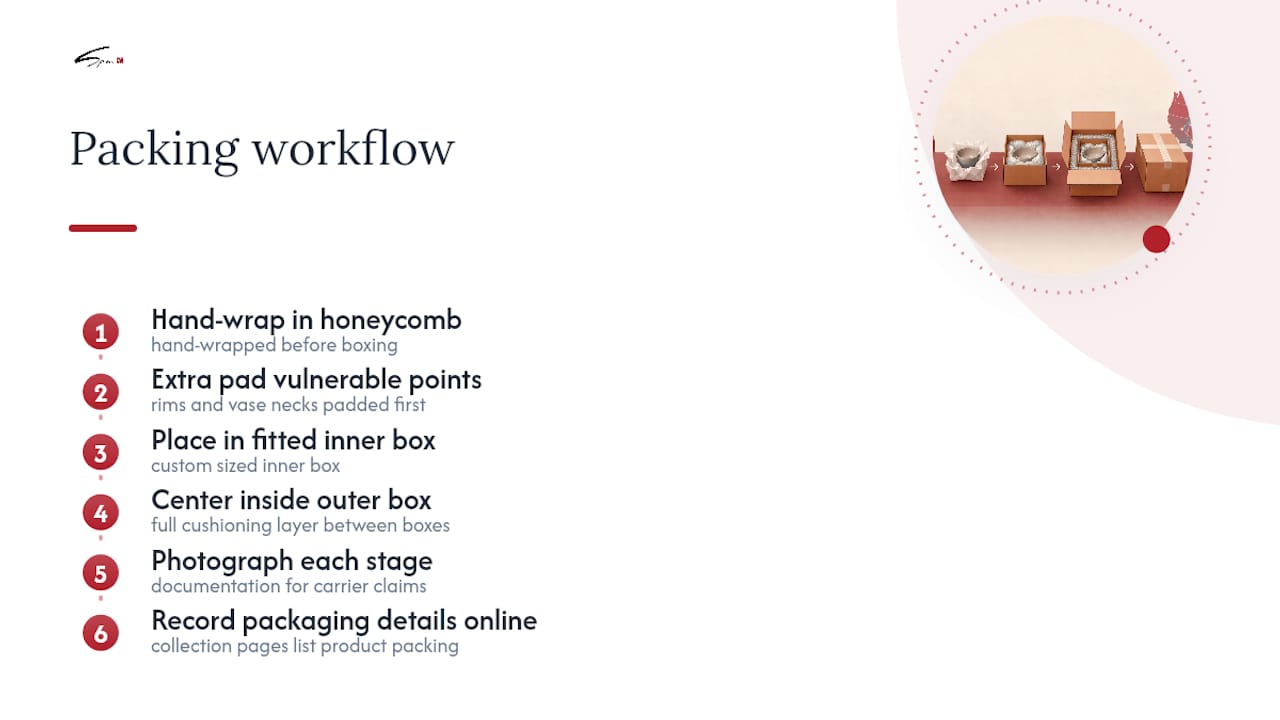
Every handcrafted porcelain piece leaving Myspinshop’s studio gets wrapped by hand in honeycomb paper before it goes into a fitted inner box, then centered inside an outer shipping box with a full cushioning layer between the two. Vulnerable points like tealight holder rims and vase necks get extra padding before anything else touches them. The studio photographs each stage as it goes, the same documentation habit that protects any seller against a carrier claim dispute. Product and gift-packaging details live on the tealight holder collection and vase collection pages.
What I’ve Learned Watching Ceramics Break (and Not Break) in Transit
Most breakage comes down to one habit skipped, not one dramatic drop. Sellers who skip the shake test almost always find out the hard way that a quarter inch of wiggle room is all it takes. If you remember nothing else: immobilize the piece, double-box it, shake it before you seal it, and photograph every layer as you go. That routine, repeated the same way every time, is what separates sellers who never deal with a broken-item complaint from the ones fighting carrier claims every month. Fine porcelain in particular, thinner and less forgiving than stoneware, punishes shortcuts fastest.
— Alan
Where to Find MySpinShop’s Handcrafted Porcelain Collections
Myspinshop is the alternative to mass-produced décor for anyone who wants a piece with real craft behind it and the packing to match. Every tealight holder, vase, bowl, plate, and cup is hand-produced in limited quantities using traditional techniques rooted in Jingdezhen’s porcelain heritage, so what arrives at your door isn’t something stamped out by the thousand.
Packages ship using the same double-box method covered above, with honeycomb paper protecting glazed surfaces and photo documentation kept on file for every order. If a piece somehow arrives damaged, that documentation is what makes a replacement conversation fast instead of frustrating. Browse the full tealight holder, vase, bowl, plate, and cup collections to see current pieces, or check the wabi sabi ceramics guide if you’re deciding between porcelain and stoneware for a gift. Pick a piece, and the packing question is already handled.
Sources
- How to Ship Ceramics & Pottery | ShippingLabel
- How To Pack and Ship Ceramics and Fragile Objects — The Studio Manager
- Shipping Pottery & Ceramics Without Breakage: Complete Guide | atoship
FAQ
What Is the Best Way to Ship Ceramics?
Immobilize the piece with padding so nothing can shift, then use the double-box method: an inner box with 2 inches of cushioning, placed inside an outer box with another 2 inches of cushioning around it. This 2-2-2 approach is the trade standard because it stops both impact and internal movement, the two main causes of breakage.
Which Carrier Is Best for Shipping Fragile Items?
No single US carrier guarantees gentler handling of fragile parcels, but FedEx Ground and UPS Ground tend to route ground packages through fewer manual sorting touches than USPS. Whichever carrier you choose, declared value and solid documentation matter more than the carrier logo on the label.
Can You Fly With Ceramics in Your Carry-On?
Most airlines allow ceramics in carry-on luggage, since TSA screens for prohibited items rather than fragility, but you’re responsible for cushioning the piece yourself with clothing or bubble wrap. Checked luggage is riskier for ceramics because of rougher handling and less control over impact, so carry-on is generally the safer route for a piece you can’t afford to lose.
What Is the Best Way to Ship a Fragile Item in General?
The same double-box, 2-inch-cushioning method used for ceramics applies to most fragile items, including glassware: immobilize it, pad any vulnerable points like stems or handles, and run a shake test before sealing. Photograph the packing at each stage so you have proof of proper packaging if a carrier questions a damage claim.
Does MySpinShop Ship Fragile Porcelain Safely?
Myspinshop packs every order using the double-box method with honeycomb paper cushioning and photo documentation at each stage, the same process outlined throughout this guide. Current product pricing is listed directly on the MySpinShop storefront.