
Chinese Porcelain Techniques: Materials, Firing, Decoration

Chinese porcelain techniques are the material recipes and stepwise craft processes that turn raw clay into a hard, translucent ceramic body: preparing a kaolin-based paste, shaping it, applying a glass-forming glaze, painting it in one or more decoration systems, and firing it hot enough to fuse everything into glass. Every piece that survives from the Song dynasty to a contemporary studio in Ohio depends on getting those five stages right.
A reader chasing this phrase usually wants the whole system, not one slice of it. Here’s the shape of it:
-
Body composition: kaolin clay mixed with flux materials for whiteness, plasticity, and strength
-
Forming: wheel-throwing, molding, or slipcasting the raw paste into shape
-
Glazing: applying a silica-alumina-flux coating that turns glassy in the kiln
-
Decoration: underglaze cobalt painting, overglaze enamels, or both combined
-
Firing: reaching kiln temperatures high enough to vitrify the body and fuse the glaze
Jingdezhen, in Jiangxi province, became the center of gravity for this entire system because it had the raw kaolin deposits and the organized workshops to standardize it at scale.
Key Takeaways
True Chinese porcelain depends on a kaolin-flux body vitrified above roughly 1,200°C, shaped and glazed with methods refined over centuries, then decorated with underglaze cobalt, overglaze enamel, or both.
| Point | Details |
|---|---|
| Vitrification is the core test | A well-fired kaolin-flux body should ring clearly, show translucency, and absorb almost no water. |
| Underglaze and overglaze are distinct systems | Cobalt blue-and-white fires once under the glaze; enamel palettes like famille rose need a second, lower-temperature firing. |
| Atmosphere shapes color | Reduction firing turns celadon’s iron content green; oxidation pushes the same glaze toward brown. |
| Jingdezhen’s edge was organizational, not just material | Local kaolin plus a specialized, multi-step workshop system produced imperial-grade consistency. |
| Craftsmanship still applies these principles | Myspinshop builds handcrafted vases, teaware, and tealight holders using the same body, glaze, and firing techniques explained above. |
Table of Contents
-
What Are the Core Materials Behind Chinese Porcelain Techniques?
-
How Are U.S. Studios Adapting These Traditional Methods Today?
-
Why Understanding These Techniques Changes How You Look at Porcelain
What Are the Core Materials Behind Chinese Porcelain Techniques?
Kaolin is the ingredient that separates porcelain from every coarser ceramic. It’s a white, fine-grained clay made mostly of the mineral kaolinite, and its particle structure gives fired ware three qualities that low-fired earthenware never achieves: bright whiteness, enough plasticity to hold a thin wall, and, once vitrified, genuine translucency when held to light.
Kaolin alone is too refractory to melt into a dense body at reasonable kiln temperatures. Potters blend it with fluxes, historically petuntse (a partially decomposed feldspathic rock, sometimes called “porcelain stone”) along with feldspar and, in some later recipes, ground glass or bone ash. These fluxes lower the melting point of the mixture so the whole body can vitrify rather than simply harden. Quartz is often added too, contributing structural rigidity and helping control shrinkage during drying and firing.
Vitrification is the technical event that makes porcelain porcelain. As the body approaches its firing peak, the flux components begin to melt and flow, filling the spaces between kaolin and quartz particles with a glassy matrix. The result is a ceramic that’s essentially glass-bonded stone: impervious to water, mechanically strong for its thinness, and translucent where the wall is thin enough. According to the Phoenix Art Museum’s technical overview, this transformation happens in a firing range of roughly 1,200 to 1,400 degrees Celsius, and hitting that window with a well-balanced kaolin-flux mix is the central technical achievement behind what collectors call “true” porcelain.
Statistic Callout: The Smithsonian’s National Museum of Asian Art notes that the finest porcelains are commonly fired above 1,260°C (2,300°F), a threshold well beyond what typical stoneware or earthenware clays can survive without slumping or bloating.
Makers and conservators don’t just trust the thermometer. They rely on a handful of low-tech, high-reliability checks that have barely changed in centuries:
-
Ring test: tapping a fired piece and listening for a clear, bell-like tone rather than a dull thud, which signals a dense, well-vitrified body
-
Translucency check: holding thin walls to a light source; true porcelain glows evenly rather than staying opaque
-
Whiteness and grain: a fired cross-section should show a fine, even, white to slightly gray body with no visible coarse particles
-
Water absorption: a vitrified body should absorb close to none, unlike stoneware, which retains measurable porosity
Modern labs echo the same distinction between high-fired translucent porcelain and lower-fired stonewares, typically drawing the line around 1,250 to 1,350°C, with the ring and translucency tests still doing frontline duty in workshops that don’t have a kiln log handy.
| Material | Role in the Body | Effect on Finished Ware |
|---|---|---|
| Kaolin | Primary clay, source of whiteness and plasticity | Fine white body, capacity for thin walls |
| Feldspar | Flux, lowers melting point | Enables vitrification, adds translucency |
| Quartz | Filler, structural stability | Reduces shrinkage, adds rigidity |
| Petuntse | Traditional feldspathic flux (historical) | Classic Jingdezhen recipe component |
For a studio maker, the balancing act is real. More kaolin gives you a stronger, whiter body but stiffer, less workable clay. More flux gives you better vitrification and translucency but a paste that’s harder to throw thin without slumping in the kiln. Getting that ratio right, tuned to your specific clay source and firing schedule, is exactly the kind of studio recipe adjustment that separates a piece that pings like a bell from one that thuds.
How Was Porcelain Shaped Before Modern Tools Existed?
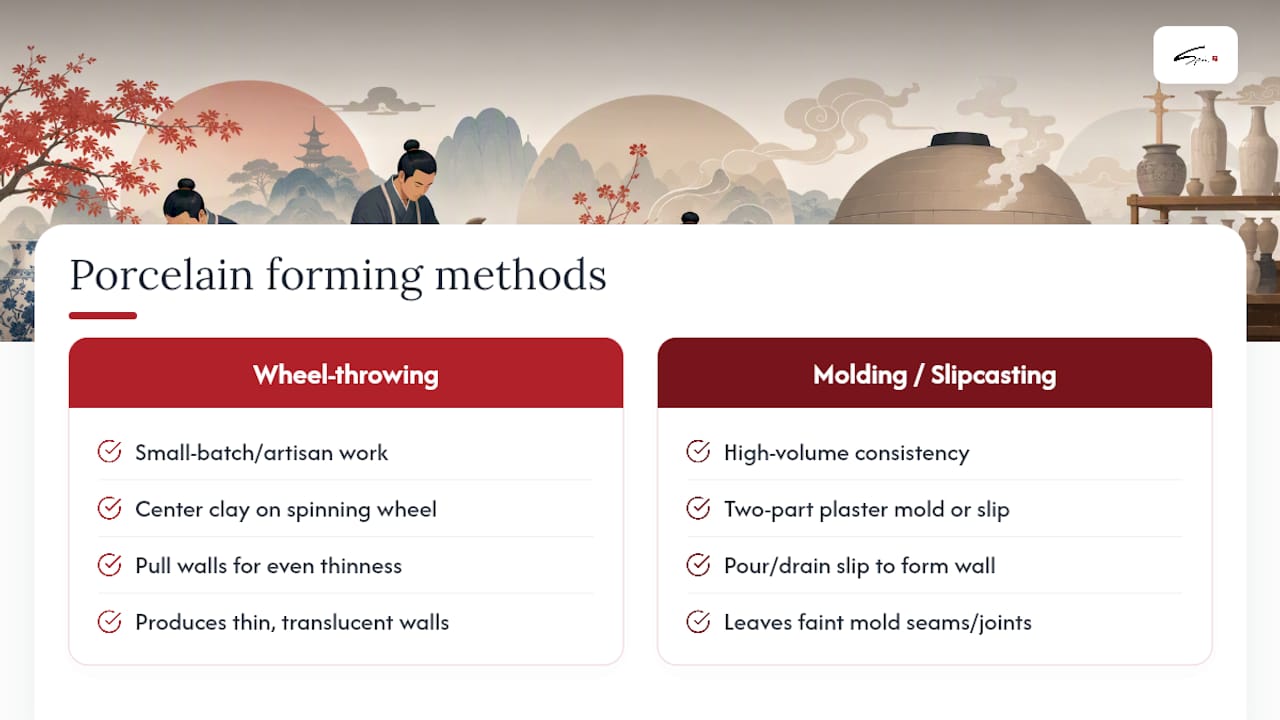
Wheel-throwing is the technique most people picture when they think of porcelain forming, and for good reason. A potter centers a ball of prepared clay on a spinning wheel and pulls the walls up and out with steady hand pressure, using the clay’s own plasticity and centrifugal motion to thin it evenly. Thin-walled bowls and cups, the kind that show real translucency, depend on a potter’s ability to pull consistent wall thickness while the piece is still spinning, then trim it lighter once leather-hard.
Molding and slipcasting solved a different problem: consistency at scale. Imperial workshops needed hundreds of matching bowls or plates for court use, and a single potter throwing each one by hand couldn’t guarantee identical proportions. A two-part plaster mold, or a liquid clay slip poured into a mold and drained once a wall had set against the plaster, let workshops turn out nearly identical forms quickly. Conservators looking at excavated imperial ware often spot faint mold seams or joint marks along the interior, a quiet giveaway that a piece was cast rather than thrown.
Before firing, decorators had several ways to add dimension without paint. Carving cut crisp lines directly into the leather-hard body. Incising created finer, shallower detail work, often under a monochrome glaze like celadon where the glaze pools slightly darker in the recessed lines. Sprigging applied separately molded relief elements, pressed onto the still-damp body, a technique common on some export wares and decorative vessels.
Drying practice matters more than most buyers assume. Porcelain bodies shrink as they dry, and uneven drying, one side exposed to airflow while the other stays damp, is a leading cause of warping and hairline cracks that don’t show up until the kiln. Trimming a thrown piece only once it’s reached a uniform leather-hard state, and drying finished greenware slowly under loose plastic, avoids most of the cracking that ruins an otherwise good throw.
Pro Tip: If you’re working with a porcelain slip at the studio level, keep your walls no thinner than roughly 3 millimeters until you’ve fired a few test pieces from that specific clay batch. Porcelain slips shrink more aggressively than stoneware, and a wall that looks fine leather-hard can develop invisible stress cracks that only reveal themselves at peak temperature.
What Glaze Chemistry Produces Celadon and Qingbai Colors?
Glaze is its own small chemistry experiment layered on top of the body. A basic Chinese porcelain glaze combines silica (the glass former), alumina (which controls viscosity and prevents the glaze from running off the piece), and a flux, commonly a feldspar, lime, or wood-ash source, that lowers the melting point so the glaze fuses at the same general temperature as the body beneath it. Shift those ratios even slightly and you shift the glaze’s melting behavior, its gloss, and how it interacts with the atmosphere inside the kiln.
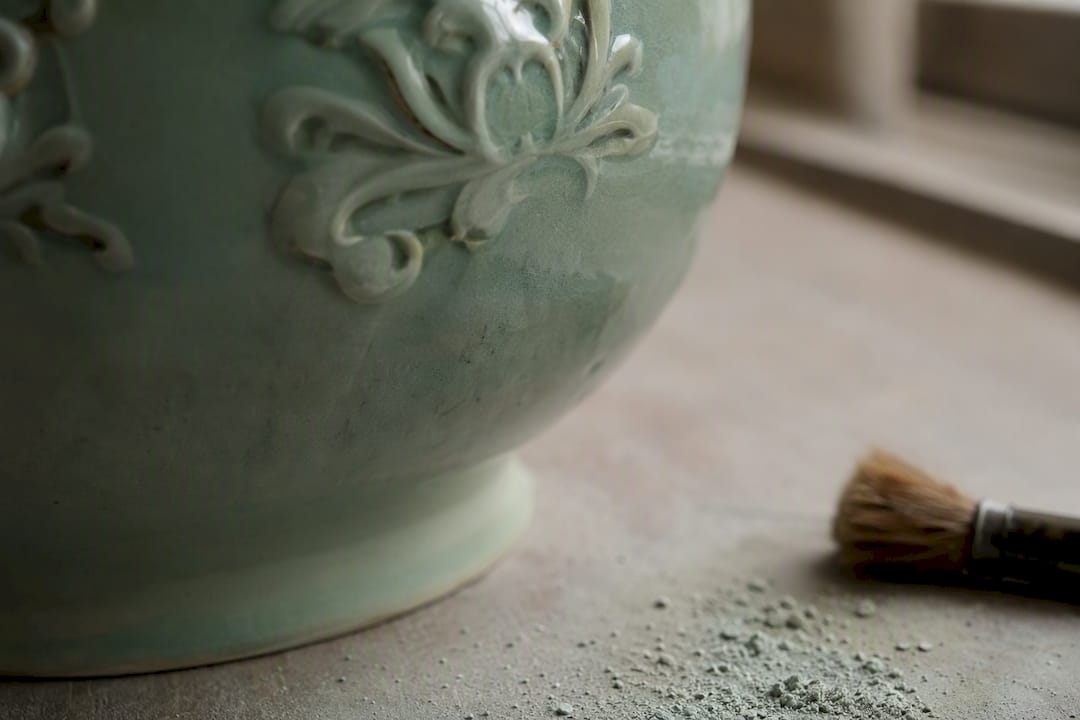
Celadon is the clearest example of atmosphere doing the chemical work. The glaze itself contains a small amount of iron oxide, usually just one or two percent. Fired in an oxygen-rich atmosphere, that iron would fire toward brown or amber. Fired instead in a reduction atmosphere, one where the kiln is starved of oxygen and combustion strips oxygen from the glaze’s iron compounds, the same glaze turns the cool jade green to olive gray that celadon is known for. It’s the same recipe; the fire itself is doing the coloring.
Qingbai (“blue-white”) works on a different principle entirely. It’s essentially a nearly transparent, high-lime glaze applied over a very white porcelain body, sometimes with the faintest trace of iron. The pale blue-white cast that gives qingbai its name comes largely from how that thin, glassy glaze scatters light over the white body beneath it, especially where the glaze pools thicker in carved or incised decoration. It’s an optical effect built on the interaction between a clear glaze and a bright body, not a heavily pigmented glaze in its own right.
Transparent glazes used over blue-and-white and other decorated wares carry their own technical headaches. Two defects show up constantly in both historical kiln wasters and modern studio tests:
-
Crawling, where the glaze pulls back from the body during firing and leaves bare patches, usually from dust, grease, or an overly thick glaze application
-
Crazing, a network of fine surface cracks caused by a mismatch between the glaze’s shrinkage rate and the body’s, often from a glaze that contracts more than the clay beneath it
Pro Tip: Match your glaze’s thermal expansion to your body’s vitrification point before you worry about color. A glaze recipe copied from a different clay body, even one that fires at the same peak temperature, can craze or crawl simply because the two materials cool and shrink at different rates.
What Decoration Systems Define Chinese Porcelain?
Underglaze painting is the technique behind blue-and-white ware, and it’s technically demanding for a specific reason: the pigment has to survive the same high-temperature firing as the body and glaze. Cobalt oxide, ground fine and mixed with water or tea, is painted directly onto the unfired or bisque-fired body, then sealed under a transparent glaze before a single high firing. Because the cobalt sits under the glass layer, it fuses into the glaze itself rather than sitting on top of it, producing that characteristic soft-edged blue that reads as part of the surface rather than a coating on it. Jingdezhen potters spent much of the Yuan dynasty refining this exact combination of clay body, cobalt source, and firing schedule, and by the sixteenth century blue-and-white had become one of China’s most significant export goods.
Overglaze enamels work the opposite way. These pigments, including the well-known famille rose, famille verte, and falangcai palettes, are painted onto a piece that’s already been glazed and fired once. The decorated piece then goes through a second, much lower-temperature firing, often in the range used for enameling metal, just hot enough to fuse the enamel onto the glaze surface without melting the glaze itself. This lower firing temperature is what allows overglaze palettes to include colors, like certain pinks, yellows, and delicate greens, that couldn’t survive the intense heat underglaze painting requires.
Doucai and wucai are where these two systems meet on the same piece. In doucai (“contrasting colors” or “joined colors”), a design is first outlined in underglaze cobalt blue and fired, then the piece is returned to the decorator’s bench, where overglaze enamels fill in the remaining color within or around those blue outlines, followed by a second, lower firing. Wucai follows a related logic, generally using underglaze blue as one color among a bolder overglaze palette rather than as a pure outline structure, and both approaches reached their technical peak during the Qing dynasty.
Collectors and conservators use a handful of visual cues to sort out which technique made a given piece:
-
Brush stroke crispness: underglaze cobalt tends to soften slightly at the edges under the glaze, while overglaze enamel strokes sit crisper, closer to the surface
-
Surface texture: overglaze enamels often stand in faint relief you can feel with a fingernail; underglaze decoration is flush with the glaze surface
-
Glaze pooling: transparent glaze pools slightly at the edges of underglaze cobalt lines, a small but consistent tell
-
Color palette range: pure underglaze work is essentially monochrome (blue, occasionally copper red); a wide, bright palette signals overglaze enamel involvement
Pigment sourcing shaped both the look and the reliability of underglaze work for centuries. Historically, much of the cobalt used at Jingdezhen came from Yunnan province, though imported cobalt (sometimes called “Mohammedan blue”) was prized in earlier periods for its purity and produced a deeper, more saturated tone than some domestic sources. Impurities in a given cobalt batch, particularly manganese content, could shift the fired color toward gray or violet, which is one reason blue-and-white from different periods and regions shows such a visible range of blue tones even when the painting style is similar.
How Do Kiln Type and Firing Atmosphere Shape the Result?
The dragon kiln, also called a climbing kiln, is one of the most consequential pieces of hardware in Chinese ceramic history. Built up a hillside slope, often 100 feet or more in length, its long tunnel shape let heat and flame travel naturally upward from a firebox at the base to a chimney effect at the top. That slope did two things at once: it let a single firing produce a huge volume of ware, and it created a temperature gradient along the kiln’s length, hotter near the firebox, cooler toward the top, that experienced potters exploited by stacking different wares in the zones best suited to their firing needs.
Getting a kiln to vitrify porcelain reliably takes attention to a few interacting variables:
-
Peak temperature, generally in the 1,200 to 1,400°C range for a true porcelain body, depending on the specific kaolin-flux mix
-
Ramp rate, how quickly the kiln climbs to peak temperature, since too fast a ramp can crack thick-walled pieces from thermal shock
-
Soak time, holding near peak temperature long enough for vitrification to complete evenly through the body, not just at the surface
-
Atmosphere control, switching between oxidation and reduction at specific points in the firing to trigger color changes in iron-bearing glazes
-
Cooling rate, since cooling too quickly can crack a dense vitrified body just as easily as heating it too fast
Atmosphere is where a lot of the visual drama happens. In an oxidation atmosphere, plenty of air reaches the fire, combustion is complete, and iron oxides in a glaze tend to stay in their more oxidized, redder or browner form. In a reduction atmosphere, the kiln is starved of oxygen, often by restricting air intake or adding extra fuel, and the resulting incomplete combustion pulls oxygen out of the glaze’s iron compounds instead. That’s the mechanism behind celadon’s green cast and behind some of the darker brown-black glazes associated with northern Song wares.
Statistic Callout: The 1,260°C threshold cited by the Smithsonian for fine porcelain isn’t just a body benchmark, it also sets a ceiling for what pigments can survive underglaze. Overglaze enamel palettes exist largely because certain colors simply can’t tolerate that heat and need the gentler, lower-temperature second firing instead.
Traditional egg-shaped and long climbing kilns create genuinely complex internal temperature gradients, and experienced kiln masters adjusted fuel type, airflow, and where pieces sat in the stack to create localized reduction zones without needing to control the entire kiln atmosphere at once. Loading a kiln evenly, leaving consistent spacing so flame and hot gas can circulate around every piece, remains one of the simplest and most overlooked variables in getting an even firing, whether you’re running a hillside dragon kiln or a modern electric test kiln in a garage studio.
How Did Kiln Technology and Style Evolve at Jingdezhen?
The technical story of Chinese porcelain moves through a fairly clear sequence of breakthroughs:
-
Proto-porcelain (Shang and Zhou dynasties): early high-fired stonewares reaching roughly 1,100 to 1,200°C, with natural ash glazes forming accidentally from wood-fired kiln fallout, laying the groundwork for deliberate celadon glazes centuries later
-
Tang dynasty innovations: improved kiln control and the emergence of true high-fired white wares alongside the famous sancai (three-color) lead glazes
-
Song dynasty refinement: the golden age of monochrome glazes, including classic celadon and the delicate qingbai type, prized for restraint and glaze quality over painted decoration
-
Yuan dynasty blue-and-white: Jingdezhen potters perfect the cobalt-underglaze technique, setting the template for centuries of blue-and-white production
-
Ming and Qing polychrome and imperial systems: overglaze enamels, doucai, wucai, and eventually famille rose palettes emerge alongside highly organized imperial kiln administration
Jingdezhen’s dominance wasn’t an accident of geography alone, though the local kaolin deposits (particularly from nearby Gaoling, the source of the word “kaolin” itself) gave it a real material edge. What locked in its position as porcelain’s organizing center was the workshop system built around that clay: specialized labor divided across dozens of discrete steps, from clay preparation to throwing to glazing to painting to firing, often summarized in modern accounts as a 72-step production model for imperial-grade ware. No single artisan touched a piece from start to finish; each stage had its own specialist, which is part of why imperial Jingdezhen output achieved a consistency that scattered regional kilns couldn’t match.
Certain dynasty-linked names function almost like shorthand for style and period today:
-
Ding ware: Northern Song, ivory-white glaze, often with fine incised or molded decoration
-
Ru ware: Northern Song, exceptionally rare pale blue-green glaze, made for a brief imperial window
-
Celadon: spans multiple dynasties and kiln sites, unified by reduction-fired iron glazes
-
Qingbai: Song and Yuan, translucent blue-white glaze over carved white porcelain
-
Blue-and-white: Yuan onward, cobalt underglaze painting, centered at Jingdezhen
-
Kangxi blue: Qing dynasty, prized for exceptionally saturated, evenly toned cobalt blues
How Do Collectors Verify Authenticity and Date a Piece?
Visual inspection is still the first and cheapest authentication tool available, and it starts with the body itself. A genuine antique porcelain piece should show translucency consistent with its claimed period and region, a glaze surface with age-appropriate wear patterns (not artificial scratching), and brushwork on blue-and-white pieces that matches the loose, confident linework of the era it claims. Motifs matter too: certain dragon forms, cloud patterns, and border designs are tightly associated with specific kiln eras, and a mismatch between motif and claimed date is one of the fastest tells for an experienced eye.
Laboratory science backs up or corrects what the eye alone can suggest. Thermoluminescence dating measures radiation accumulated in a fired ceramic body since its last firing, giving a reasonably reliable age estimate for excavated or unglazed ceramic material, though it has real limits: it works on the fired clay body itself, needs a sample taken from the piece, and gets less precise the closer a piece is to the present day. Pigment analysis, checking the specific chemical signature of cobalt or enamel colorants against what’s known about historical sources, helps confirm or rule out claimed periods for painted decoration, since certain pigment recipes simply didn’t exist yet at certain dates.
Relying on “it looks old” alone is one of the most common and costly mistakes new collectors make. A worn glaze or a crackled surface can be faked deliberately, and a genuinely old body can carry later restoration or repainting that changes its real value substantially. Visual assessment narrows the possibilities; only lab-grade testing, done by someone with real training in the method, closes the case on a significant purchase.
For everyday buyers, the ring test, a translucency check, and a careful look at glaze pooling around painted lines catch most obvious reproductions. Anything with real money on the line, a piece claimed to be Song or Yuan dynasty, for instance, deserves lab verification before the price reflects that claim.
How Are U.S. Studios Adapting These Traditional Methods Today?
American studio potters rarely have access to Jingdezhen kaolin, so the first adaptation is almost always material substitution: sourcing a local or commercially available kaolin and building a body recipe around its specific plasticity and firing behavior rather than trying to force a historical Chinese formula onto different clay. Electric and gas kilns replace the dragon kiln entirely, trading that dramatic temperature gradient for something a lot more valuable in a small studio: repeatability. A digital kiln controller can hold a precise ramp, soak, and cooling schedule firing after firing, which matters more for a maker selling consistent product lines than recreating an exact historical firing environment ever would.
Recreating reduction effects without a wood-fired kiln takes some creativity. Gas kilns can genuinely starve their atmosphere of oxygen to produce real reduction firing, while electric-kiln potters sometimes turn to soda or salt glazing techniques, or specialized reduction glazes formulated to shift color even in an oxidation-only environment, when they want that celadon-adjacent look without switching fuel types entirely.
Safety and sustainability have become real studio priorities in ways historical Jingdezhen workshops never had to consider. That means proper kiln ventilation, lead-free enamel formulations for anything intended to hold food or drink, and attention to firing regulations that vary by state and municipality.
-
Substitute local kaolin sources and rebuild the recipe around that clay’s specific behavior
-
Use electric or gas kilns for consistent, repeatable firing schedules
-
Reach for soda glazing or engineered reduction glazes to mimic traditional atmosphere effects
-
Prioritize lead-free enamels and adequate ventilation as non-negotiable studio standards
Pro Tip: Fire in small, deliberate batches rather than waiting to fill a large kiln. Smaller loads give you tighter control over ramp and atmosphere, which matters enormously when you’re chasing a specific glaze color, and they cut down on wasted energy from partially loaded firings.
How Do Painting and Calligraphy Shape Porcelain Decoration?
Painting on porcelain demands a different hand than painting on paper, because the surface a decorator works on, whether raw bisque or an already-glazed piece, absorbs pigment differently and offers no room for correction. Underglaze cobalt painters typically work with a loaded brush and confident, continuous strokes, since a hesitant line tends to pool unevenly and blur once the glaze melts over it in the kiln. That’s part of why experienced eyes can often distinguish genuine period brushwork from later imitation: the confidence and rhythm of the line is hard to fake convincingly.
Calligraphy appears on porcelain both as pure decoration and as functional information: reign marks on the base identifying the emperor’s era, poetic inscriptions on scholar’s objects, and dedicatory text on ceremonial pieces. These inscriptions follow the same brush conventions as ink calligraphy on paper or silk, meaning a piece’s calligraphic quality can be judged by the same aesthetic standards collectors apply to painting and scroll work, stroke weight, spacing, and the calligrapher’s control of the brush’s loading and pressure.
Overglaze enamel decoration allows finer, more detailed figural and floral painting than underglaze cobalt typically permits, since the lower second firing lets colorists build up layered, shaded effects closer to watercolor painting than the bolder, more graphic quality of underglaze work. Famille rose painters in particular developed techniques for shading within a single flower petal or figure’s robe, a level of painterly nuance that underglaze cobalt’s single firing simply doesn’t allow.
How Did Kiln Technology Change Across the Dynasties?
Kiln design didn’t leap straight from primitive pit firing to the sophisticated dragon kiln. Early Chinese potters worked with simple updraft kilns capable of modest temperatures, gradually improving insulation and airflow design across the Shang and Zhou periods to reach the higher heat that produced proto-porcelain and early ash-glazed stonewares.
The dragon kiln design, built into hillsides to use natural draft, represents the major structural leap, and it matured significantly during the Tang and Song dynasties as regional kiln sites competed to produce better wares. Archaeological excavation of kiln sites from this period, a field conservators and historians rely on heavily, has revealed wasters (failed or discarded pieces) that show how potters experimented with stacking arrangements and firing temperatures long before written records described their methods in detail.
By the Yuan and Ming dynasties, Jingdezhen’s kilns had scaled up dramatically alongside the workshop system supporting them, with kiln design increasingly optimized for the specific needs of blue-and-white production, consistent, controllable firing that protected the delicate underglaze cobalt through a single demanding high-temperature cycle. Qing dynasty imperial kilns pushed this further still, supporting the two-stage firing process, high-temperature body and glaze firing followed by a lower-temperature enamel firing, that doucai, wucai, and famille rose decoration all depend on. Each dynasty essentially inherited the previous era’s kiln engineering and pushed it toward whatever decorative technique was ascendant at the time.
Why Understanding These Techniques Changes How You Look at Porcelain
Knowing how a glaze responds to reduction, or why a cobalt line softens slightly under a clear glaze, changes what you notice when you pick up a piece. It stops being a general impression of “old and pretty” and becomes a specific set of questions: does the translucency match the claimed body type, does the blue sit under the glaze or on top of it, does the weight feel consistent with genuine vitrification.
That shift matters most at the moment of a purchase or conservation decision. A collector who can spot the difference between underglaze and overglaze decoration, or who knows what a crawled glaze looks like versus intentional texture, makes better calls on both authenticity and condition. It’s the difference between admiring a piece and actually understanding what you’re looking at.
Bring These Techniques Home With Handcrafted Porcelain
Everything covered here—kaolin body chemistry, glaze formulation, underglaze and overglaze decoration, careful kiln control—is exactly what goes into each piece Myspinshop makes by hand rather than mass-produces. When a vase leaves the studio with a spotted partridge glaze or a tealight holder achieves that eggshell-thin translucency, it’s because the same principles explained above, vitrification temperature, flux balance, controlled firing atmosphere, were managed by hand at every stage.
If the decoration systems and glaze effects in this guide caught your interest, you’ll recognize them in the pieces themselves:
-
Vases finished with reduction-fired glazes that show the same color depth as traditional celadon and rolled-clay techniques
-
Cups and teaware built with the wall-thinning and trimming methods described in the forming section
-
Tealight holders relying on eggshell-thin porcelain to achieve genuine light translucency
-
Incense burners and bowls that carry glaze textures rooted in centuries-old firing traditions
Browse the handcrafted porcelain gifts for tea lovers collection to see these techniques in finished form, or look closely at a piece like the spotted partridge glaze vase to see reduction-glaze chemistry applied to a contemporary shape. Each product page notes the finish and technique behind that specific piece, so you can connect what you just read to what you’re considering buying.
Frequently Asked Questions
What are the main Chinese porcelain techniques used historically? The core techniques are preparing a kaolin-based body with flux materials like feldspar, forming it by wheel-throwing or molding, glazing it with silica-alumina mixtures, decorating it with underglaze cobalt or overglaze enamels, and firing it at high temperature to achieve vitrification.
How is porcelain made different from regular ceramics or pottery? Porcelain uses a kaolin-rich body fired hot enough, typically above 1,260°C, to vitrify into a glass-bonded, translucent, nonporous material. Regular pottery and stoneware fire at lower temperatures and stay porous or opaque, without that glassy internal structure.
What is the difference between doucai and wucai porcelain? Doucai combines underglaze cobalt outlines with overglaze enamel fills applied in a second firing, producing a more contained, contrast-driven look. Wucai generally uses underglaze blue as one color within a bolder, more freely applied overglaze enamel palette.
Why is Jingdezhen considered the center of Chinese porcelain production? Jingdezhen sat near rich local kaolin deposits and developed a highly organized, multi-step workshop system, often summarized as a 72-step production model, that let it produce imperial-grade porcelain with a consistency scattered regional kilns couldn’t match.
How can I tell if a piece of Chinese porcelain is celadon or qingbai? Celadon shows a green to olive-gray tone from iron oxide fired in a reduction atmosphere, usually on a heavier, monochrome glazed body. Qingbai shows a pale blue-white cast created by a thin, clear glaze over a very white body, often with carved decoration visible beneath the glaze.
Can scientific testing verify the age of Chinese porcelain? Thermoluminescence dating can estimate how long ago a ceramic body was last fired, and pigment analysis can check whether a decoration’s colorants match its claimed period. Both methods have real limits and generally work best combined with visual and stylistic assessment.
Sources
A few sources go deeper into specific pieces of this picture if you want to keep researching: