
5 Steps to Retrofit Zen Home Decor This Weekend for U.S. Homes

Zen home decor means stripping a room down to a few honest, natural materials and letting imperfection show, rooted in wabi-sabi philosophy rather than sterile minimalism. The first move: pick one room or corner, clear it completely, then add back a single handmade object, like a ceramic bowl or a linen throw. Warmth and open space are the goal, not emptiness for its own sake.
TL;DR:
Use only one or two natural materials like wood, stone, or ceramics and choose restrained colors such as oatmeal, moss green, or charcoal to maintain authenticity.
Keep furniture low and intentional, with one focal point per wall, and maximize negative space to create a calming, open atmosphere.
Incorporate layered lighting near windows or with soft bulbs and add textured textiles and ceramics to build warmth and tactile interest.
Prioritize handcrafted objects like Japanese porcelain with visible glaze variation to enhance authenticity and sensory connection.
Simplify overall decor by removing excess items, focusing on meaningful pieces, and implementing small, easy weekend updates to create a serene Zen environment.
Table of Contents
What Zen Home Decor Actually Means
Zen interiors rest on three interlocking ideas: wabi-sabi, ma, and satoyama. Skip the philosophy and you get a room that looks minimalist but feels cold, which is the most common mistake homeowners make when they chase this style from photos alone.
Wabi-sabi finds beauty in imperfection: a hand-thrown bowl with an uneven rim, a wood grain left unsanded in spots. Ma is the Japanese concept of negative space, the pause between objects that gives a room room to breathe. Satoyama describes the harmony between human spaces and the natural landscape around them, which is why a Zen room always gestures toward the outdoors, even if that’s just one plant near a window.
The distinction that matters: Zen design removes objects to highlight texture and meaning, while generic minimalism removes objects to create visual austerity. That difference shows up in every choice you make:
-
Keep an object only if it has a story or a handmade quality, not just because it’s small and simple.
-
Leave a wall bare on purpose. That’s ma at work, not a decorating gap.
-
Choose one material that connects the room to something outside it. Raw wood, a river stone, dried branches.
Material Palette and Color Guidance
Wood, stone, linen, washi paper, and ceramics form the backbone of a Zen room. Each carries texture that ages visibly, which is the point. A maple side table or a raw linen cushion looks better in five years, not worse.
Color stays quiet: think sand, oatmeal, charcoal, moss green, and unbleached cotton. Pick one restrained accent, maybe a deep indigo cushion or a single terracotta vase, and let the rest of the palette stay neutral. Two or three colors total, applied consistently, reads far more authentic than five colors used sparingly. Designers who work in this style consistently recommend committing to one or two materials rather than scattering wood, stone, and metal in small doses throughout a room.
For sourcing, U.S. shoppers can find reclaimed wood furniture at salvage yards, linen bedding from most home goods retailers, and handmade ceramics through small studios or specialty shops. Substitute bamboo for oak if budget is tight. Both read as natural.

Pro Tip: If you can only change one material in a room, change the textiles first. Swapping polyester curtains for raw linen costs less than $50 and shifts the entire feel of a space.
Furniture, Layout, and Scale
Low furniture is the single fastest visual signal of Zen style, but you don’t need to replace every seat in the house. Commit to one zone.
-
Pick one seating height and stick to it. A seat height around 14 to 16 inches (roughly 35 to 40 centimeters) signals the style immediately, and practitioners point to this single change as more impactful than replacing every piece of furniture in a room.
-
Build negative space around a focal point. One low table, one cushion, one piece of art. Everything else stays clear floor.
-
Keep taller furniture elsewhere in the house for anyone who needs it for accessibility. Zen style doesn’t require sacrificing comfort for a family member who can’t easily get up from a floor cushion.
-
Anchor the eye with one object per wall, not three. A single wall hanging beats a gallery arrangement here.
Lighting and Texture That Warm a Room
Natural light does more work in a Zen room than any lamp ever will. Position seating and low tables near windows, and skip heavy drapes that block daylight, since diffuse, shaded light is part of what makes these rooms feel calm rather than stark.
When a room lacks windows, which is common in U.S. apartments and interior bedrooms, layering three light sources solves it: a warm high-CRI bulb for ambient light, a diffused task lamp for reading, and a mirror angled to bounce whatever window light exists.
Texture carries the rest of the warmth:
-
Raw or hand-finished wood grain, left visible rather than painted over.
-
Linen or cotton textiles with visible weave.
-
Unglazed or partially glazed ceramics that show the maker’s hand.
Room-by-Room: Bedroom, Living Room, and Meditation Nook
You don’t need to convert the whole house. Committing fully to one room beats a half-finished attempt spread across four.
-
Bedroom: A low platform bed frame, ideally under 18 inches off the floor, paired with unbleached linen bedding. If space allows, section off a small corner with a single tatami mat, sized to suit a cozy nook, for morning stretching or reading.
-
Living room: One low seating area built around a floor cushion or a low sofa, consistent wood tones across the coffee table and shelving, and a single ceramic statement piece, like a large hand-thrown vase, as the room’s visual anchor.
-
Meditation nook: A floor cushion, a small rug or tatami square, and a handcrafted porcelain tealight or incense holder placed within reach. This corner works in as little as 20 square feet.
Practical retrofits like a single tatami corner or shoji-style sliding panels deliver a lot of visual impact without touching structural walls, which matters if you’re renting or not ready for a renovation.
Accessories and Styling That Support the Style
The objects you choose matter more than how many you own. Wabi-sabi decorating favors a few meaningful pieces over a shelf full of small items, and that restraint is what keeps a Zen room from tipping into clutter.
Handmade ceramics work especially well here because glazing variation and visible artisan marks embody wabi-sabi directly, no interpretation needed. A single hand-thrown bowl on an otherwise bare shelf does more for the room than a curated collection of five matching objects ever could.
Build the styling layer with intent:
-
One or two plants, ideally something low-maintenance like a snake plant or a small ficus, placed near natural light.
-
A linen or hemp textile draped over a chair or folded on a shelf.
-
One or two handmade objects, ceramic or wood, with visible texture or imperfection.
Avoid synthetic imitations, plastic “wood grain” finishes, faux ceramic with a uniform glossy glaze, and the temptation to fill every open surface. A wabi-sabi ceramic piece earns its spot because it’s imperfect on purpose, not because it fills a gap.
Pro Tip: Before buying anything new, walk the room and remove three things. You’ll almost always find the room needs less, not more.
A 5-Step Plan to Make One Room Feel Zen This Weekend
You can see real change in a single room over two days without hiring anyone.
-
Friday evening: Clear one room completely except for essential furniture. Bag up anything that doesn’t serve a clear purpose.
-
Saturday morning: Swap in linen textiles, throw pillows, curtains, or a bed cover. This single change shifts the whole feel for under $100.
-
Saturday afternoon: Add one low seating element, a floor cushion or a low side table, to establish the room’s focal zone.
-
Sunday morning: Bring in one plant and one handmade object, a ceramic piece or a wood bowl, and place them with space around them.
-
Sunday afternoon: Step back and remove one more item. If the room still feels busy, it usually is.
Avoid over-accessorizing at every stage. The instinct to add a fourth or fifth decorative object is the single most common way this project goes sideways.
Water Elements for Tranquility
A water feature adds a sensory layer that static objects can’t replicate: sound. The gentle trickle of a tabletop fountain or the stillness of a water-filled bowl gives a room an ambient white noise that masks street sound and signals calm almost instantly.
You don’t need a garden pond or a wall-mounted fountain to get this effect. A shallow ceramic bowl filled with water and a single floating flower or smooth river stone works in a meditation nook or on a living room console. Small electric tabletop fountains, widely available at home goods stores, run quietly enough for a bedroom and cost relatively little to operate.

Placement matters more than size. A water bowl near a window catches light and reflects it onto a ceiling or wall, adding movement without adding visual clutter. Keep it away from foot traffic paths, since Zen water elements work as a focal point you pause at, not something you walk past constantly. In a meditation corner, position it at eye level when seated, so it becomes part of the sightline during quiet moments rather than an afterthought on a far shelf.
Maintenance is the tradeoff. Standing water needs a weekly refresh to avoid stagnant smell or algae, and a fountain pump needs occasional cleaning. If that upkeep sounds like a chore rather than a ritual, skip the water and lean harder into the visual and textural elements covered earlier. Zen decor works with substitutions.
Indoor Gardens and Bonsai
A single well-placed plant does more for a Zen room than a windowsill full of them. This is where satoyama, the connection between built space and nature, becomes tactile instead of theoretical.
Bonsai is the classic choice, and for good reason. A small juniper or ficus bonsai on a low shelf or side table brings the shape and discipline of a full-grown tree into a few square inches. Bonsai does require real commitment, regular pruning, careful watering, and enough indirect light, so it’s a better fit for someone who wants a plant relationship, not just a plant.
If that commitment feels like too much right now, a small indoor garden works just as well. A shallow tray with moss, a few smooth stones, and one or two low succulents creates a miniature landscape you can maintain in five minutes a week. Snake plants, pothos, and ZZ plants are common low-maintenance substitutes that still deliver the greenery a Zen room needs without demanding bonsai-level attention.

Group plants in odd numbers, one or three, rather than even pairs, and keep them near a light source rather than tucked in a dark corner where they’ll struggle and eventually look neglected instead of natural. The goal is a plant that looks alive and intentional, not a plant that’s merely present.
Choosing Zen-Inspired Artwork and Decor
Art in a Zen room should do one job: draw the eye to a single point, then let the room’s negative space take over. That’s the opposite of gallery-wall thinking, where more frames mean more visual interest.
Look for pieces with restraint built in. Ink wash paintings, sumi-e style brushwork, a single branch or mountain rendered in a few strokes, work because they leave as much unsaid as they show. A large piece of blank or near-blank space within the frame mirrors the ma principle you’re already applying to the room itself.
Photography works too, especially black-and-white landscape or nature shots with a lot of open sky or water. Avoid busy patterns, bright saturated colors, or anything with text. Those pull attention in multiple directions, which fights against the calm you’re building.
One piece per wall, sized to fill roughly a third to half the wall’s width, tends to look intentional rather than sparse. A single hand-thrown ceramic plate mounted as wall art, or a wood carving with visible grain, does the job of a painting while adding the textural quality wabi-sabi calls for. Skip the temptation to layer multiple small prints in a frame cluster. That’s a different style entirely, and it undercuts everything the rest of the room is doing.
Feng Shui Principles Worth Borrowing
Zen decor and Feng Shui come from different traditions, Zen from Japanese Buddhist aesthetics and Feng Shui from Chinese philosophy, but a few Feng Shui principles overlap naturally with what a calm room already needs.
The first is clear pathways. Feng Shui treats blocked walkways as blocked energy, and practically speaking, a room you can move through without obstruction simply feels calmer. Keep the space between furniture pieces open enough to walk through without turning sideways.
The second is the placement of a bed or main seat against a solid wall rather than floating in open space, giving it a sense of support and visibility toward the room’s entrance. This lines up neatly with the low platform bed setup already ideal for a Zen bedroom.
Third, Feng Shui favors balance across the five elements, wood, fire, earth, metal, and water, represented through material choices rather than literal objects. A Zen room already leans hard on wood and earth tones, so adding one small metal accent, a bronze bowl or a brushed steel lamp base, and one water element rounds out that balance without requiring a full Feng Shui consultation.
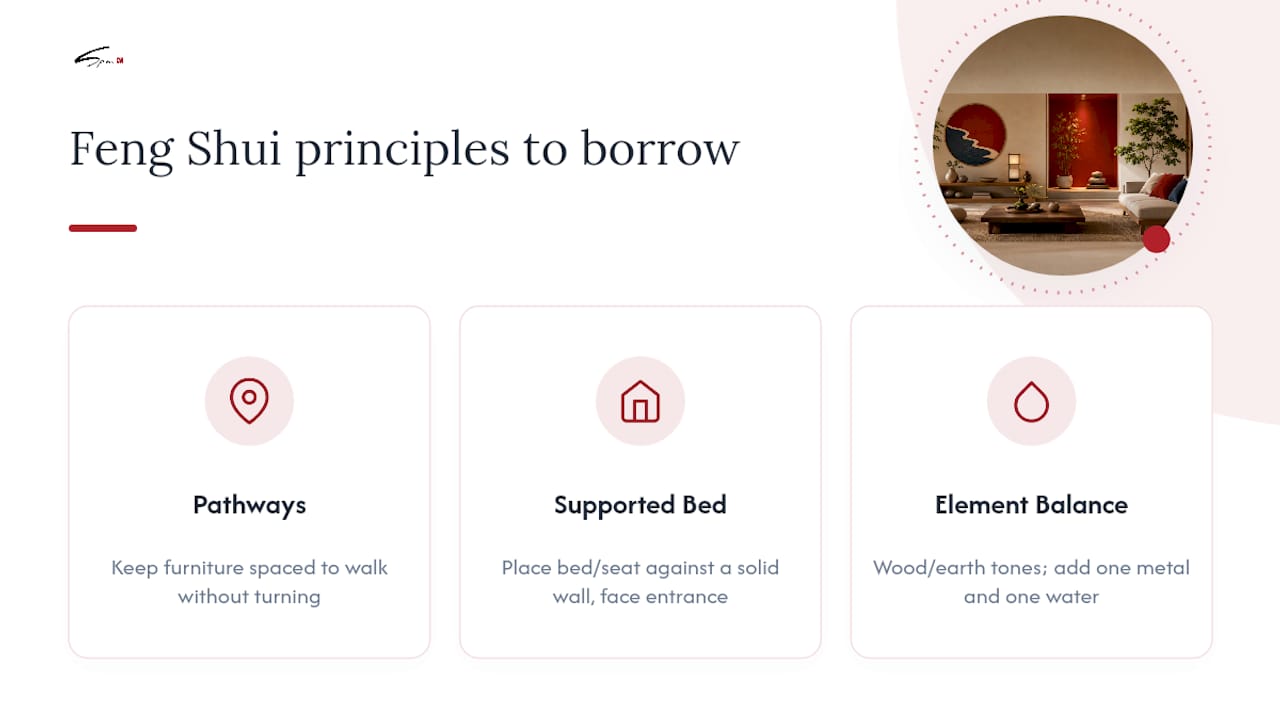
You don’t need to follow Feng Shui as a complete system to borrow these three ideas. They reinforce the same goal Zen decor already has: a room that feels supported, open, and balanced rather than staged.
Why Handcrafted Porcelain Belongs in a Zen Room
The gap between a Zen room that photographs well and one that feels calm to live in usually comes down to touch. Mass-produced decor looks fine in a photo, but it rarely holds up to daily contact the way a hand-thrown piece does. Some handcrafted porcelain designed with traditional Chinese techniques shows glazing variation that fits the imperfection wabi-sabi values.
One piece, a tealight holder or a simple bowl, adds tactility and a real story to a room. Porcelain isn’t the only authentic material that works here. Wood, stone, and linen matter just as much, and a room built entirely from ceramics would miss the point.
— Alan
Bring Handcrafted Porcelain Into Your Zen Corner
A genuinely handmade focal object, not a mass-produced stand-in, adds the detail most Zen rooms miss. Such pieces designed and hand-produced using traditional Chinese porcelain techniques have authentic glaze variation and subtle imperfections, not printed on.

For the room-by-room projects covered above, a few pieces do the most work. A simple tealight holder anchors a meditation nook without adding clutter. A single porcelain vase, left mostly empty or holding one branch, becomes the living room’s focal point. An incense burner brings scent and ritual into a reading corner without needing anything else on the shelf. Browse the full collection at MySpinShop and pick one piece that fits the room you’re working on this weekend. Start with the corner you already cleared, and let one handmade object finish it.
Sources
-
Japan style interior design: Wabi-Sabi, minimalism, and natural materials
-
Japanese design principles for contemporary interiors | HomeWorldDesign