
Protect Lungs at Home: Incense or Diffuser for U.S. Homes

Pick incense when you want a fast, intense burst of scent for a ritual, a meditation session, or a quick mood shift. Pick a diffuser when you want steady, adjustable background fragrance you can run all day without smoke. If anyone in the house has asthma or lung sensitivity, lean toward diffusers or well-ventilated, short incense sessions, and use a stable porcelain burner to keep ash and heat contained safely.
TL;DR:
Incense produces immediate, intense scent with a smoky, layered aroma, but it releases fine particles that can irritate lungs in enclosed spaces.
Diffusers eliminate combustion byproducts and provide a steady, adjustable mist, making them safer for households with respiratory sensitivities or pets.
Short incense sessions in well-ventilated areas are less likely to cause health issues, but diffuser cleaning is essential to prevent mold and bacteria buildup.
Incense costs are low upfront, mainly for sticks and burners, while diffusers require a larger initial investment but consume less ongoing expenditure.
Choosing the right scent method depends on room size and purpose: incense suits quick rituals, while diffusers favor long-term background fragrance.
Table of Contents
How Incense and Diffusers Actually Work
Incense burns. That’s the whole mechanism, and it explains almost every difference on this list. A stick, cone, or coil is made from compressed plant material, resin, or wood powder bound with a combustible base, and lighting it starts a slow-moving ember that releases fragrant smoke as it travels down the material. Burn time depends on format: thin sticks typically last from a half-hour up to less than an hour, cones burn faster, and coils can smolder for longer durations, which is why coils show up in temples and larger rooms where longer coverage matters.
Diffusers skip combustion entirely and rely on one of several physical processes to move scent into the air.
-
Reed diffusers use porous sticks to wick liquid fragrance upward passively, no power or heat required.
-
Ultrasonic diffusers vibrate a water and oil mixture into a fine mist, doubling as a light humidifier.
-
Nebulizing diffusers atomize pure essential oil directly, without water, producing the strongest waterless scent output.
-
Evaporative diffusers pull air across an oil-soaked pad or filter using a small fan.
-
Electric or heat diffusers warm oil gently to speed up evaporation, similar to a wax warmer.
Each method changes how scent behaves in a room. Combustion breaks down aromatic compounds and adds smoke, so incense tends to smell warmer, smokier, and more layered than the raw oil it started from. That smoke also clings to curtains and upholstery, which is part of why incense feels so ritualistic and part of why it lingers longer than a diffuser’s mist. A guide on optimizing scent usage makes a similar point about matching intensity to room size, since a technique that works in a small bathroom can overwhelm an open living room.
Incense vs. Diffuser: Weighing the Trade-Offs
Neither method wins across every category. Here’s how they stack up on the factors that actually change daily experience.
-
Scent intensity and speed. Incense delivers an immediate, bold hit of fragrance within minutes of lighting it. Diffusers build scent gradually and let you dial intensity up or down, which suits people who find sudden strong smells irritating.
-
Ambiance and ritual. A lit stick, curling smoke, and a small flame create a sensory moment diffusers can’t replicate. Diffusers offer a quieter, more modern presence, often paired with a soft light rather than fire.
-
Convenience and control. Diffusers can run on a timer, refill less often, and don’t need direct supervision the way an open flame does. Incense needs a lighter, a fireproof holder, and someone paying attention while it burns.
-
Maintenance load. Incense leaves ash to sweep and needs a fresh stick every session. Water-based diffusers need regular reservoir cleaning, and nebulizing units need occasional oil-line flushes.
-
Household safety. Open flame and hot ash pose real risks around toddlers, pets, and curious cats knocking over a burner. Diffusers remove the flame risk but introduce electrical cords and small parts that some pets chew.
-
Renter and building rules. Many apartment leases and some smoke detectors flag incense smoke, while diffusers rarely trigger the same restrictions.
The pattern is pretty clear: incense wins on drama and speed, diffusers win on control and low-effort safety. Households with birds or cats need extra caution either way, since concentrated oils and heavy smoke both affect small animals faster than they affect people.
Is Incense or a Diffuser Better for Your Lungs?
Combustion is the core issue with incense, and the science on this is consistent. Burning incense releases fine particulate matter, volatile organic compounds, and other byproducts that irritate the respiratory tract, according to the American Lung Association. A peer-reviewed review of indoor air studies found that incense smoke measurably raises indoor particulate levels, comparable to other combustion sources like candles or cigarettes in enclosed spaces, and recommends ventilation and limited use for anyone with existing lung conditions, according to a review published on PubMed Central.
Diffusers sidestep combustion, which removes the particulate matter problem, but they aren’t risk-free. Essential oils are volatile organic compounds themselves, and concentrated exposure can irritate eyes, airways, or skin in sensitive people, especially in small, poorly ventilated rooms. Water-based ultrasonic units carry a separate concern: a damp reservoir left uncleaned becomes a breeding ground for mold and bacteria that get dispersed right along with the mist, according to reporting from the Baltimore Sun on essential oil diffusers versus incense.
A quick reality check: incense smoke behaves like other indoor combustion pollution, and that’s not a minor detail if you already manage asthma, COPD, or allergies.
Some practical steps cut most of the risk without giving up scent entirely:
-
Keep incense sessions short and well-ventilated, such as in a room with a cracked window or running exhaust fan.
-
Choose natural resins and woods over cheap synthetic incense, which tends to produce harsher, more irritating smoke.
-
Clean diffuser reservoirs every few days, not just when they run dry.
-
Never run incense and a diffuser in the same room at the same time. Doing so stacks particulate smoke on top of volatile compounds, which increases irritation risk and can trigger scent fatigue.
-
Skip both methods around infants, anyone on oxygen therapy, and pets sensitive to concentrated oils like tea tree.
What Does Each Option Actually Cost Over Time?
Incense is cheap upfront and stays cheap. A box of 20 to 40 sticks typically runs a few dollars and lasts weeks of casual use, so the ongoing cost is mostly about how often you light one, not what you paid for a device. Diffusers flip that equation: you pay more upfront for the machine and less per session afterward, since a small bottle of essential oil can stretch across dozens of uses depending on the diffuser type.
-
Incense: low upfront cost, consumable expense that repeats every session, burn times of 30 to 90 minutes per stick or coil.
-
Ultrasonic and evaporative diffusers: moderate device cost, functional lifespan of roughly two to five years depending on how well the reservoir and internals are maintained, according to consumer comparisons of incense and essential oil diffusers.
-
Nebulizing diffusers: higher upfront cost and pricier pure oils, but no water dilution and stronger scent throw per drop.
-
Reed diffusers: minimal cost, no electricity, but reeds need replacing every few months as they clog with dust and residue.
Maintenance time matters as much as dollars. Incense needs ash swept after nearly every burn, a thirty second task that adds up. Diffusers need a real cleaning cycle, wiping the reservoir and running a vinegar rinse every one to two weeks for ultrasonic models, or the microbial buildup mentioned earlier starts working against you.
Choosing the Right Method Room by Room
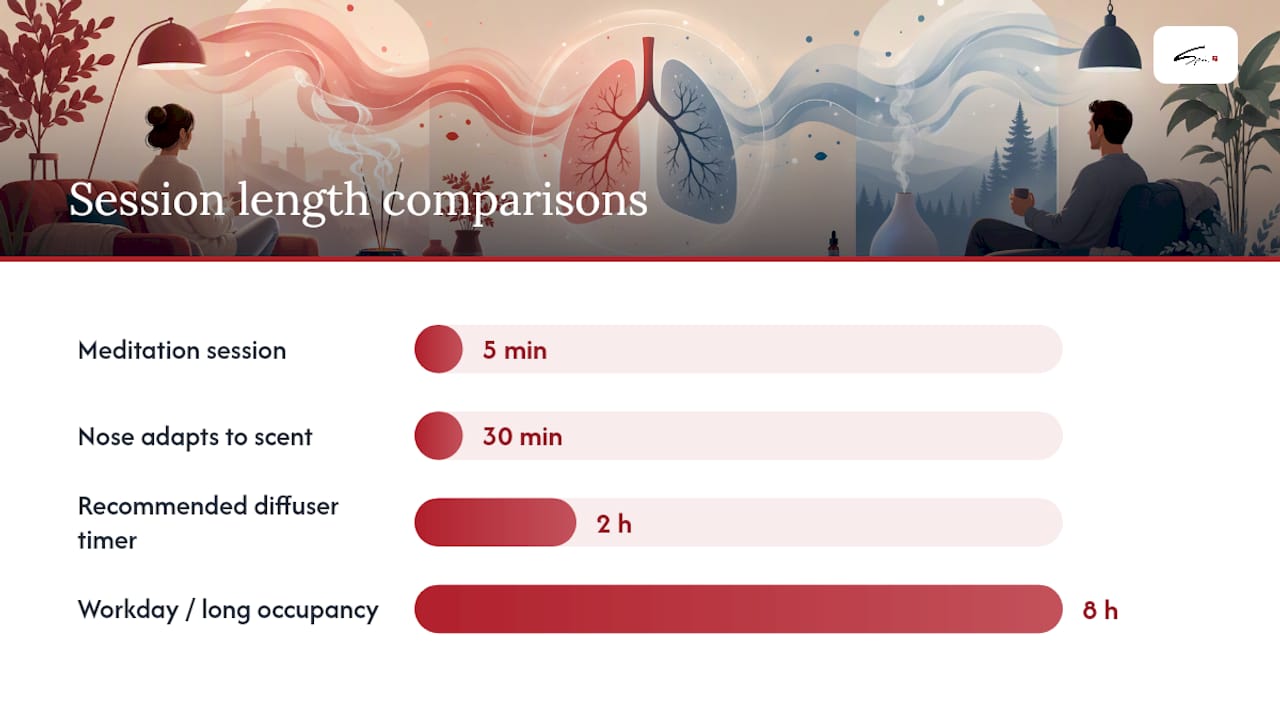
Match the tool to the moment instead of picking one method for the whole house. A five minute meditation session and an eight hour workday call for different approaches entirely.
Incense earns its place in short, intentional windows: a meditation corner, a quick scent reset after cooking, or a ritual space where the smoke and flame are part of the experience, not just a delivery method. It works best in rooms with some airflow, like a cracked window or a doorway to a hallway, where smoke doesn’t pool.
Diffusers make more sense for anything that runs for hours. Bedrooms, home offices, and living rooms where people spend extended stretches all benefit from a slow, adjustable mist rather than repeated smoke exposure. Households with a family member who has asthma or allergies should default to diffusers, and even then, keep sessions moderate and cleaning routines consistent.
-
Meditation or ritual spaces: incense, short sessions, good airflow.
-
Bedrooms and offices: diffuser on a timer, low to medium mist setting.
-
Households with breathing sensitivities: diffuser only, or skip both in favor of a reed diffuser.
-
Homes with birds or reptiles: avoid nebulizing diffusers and heavy incense use near their enclosures.
When neither option feels right, a passive reed diffuser or a flameless wax warmer gives you ambient scent without smoke, mist, or moving parts, which suits renters with strict lease terms or anyone managing a serious respiratory condition.
Pro Tip: Run a diffuser on a two hour timer instead of leaving it on all day. Your nose adapts to steady scent within thirty minutes anyway, so the extra hours mostly waste oil without adding noticeable fragrance.
Why the Vessel Matters as Much as the Scent
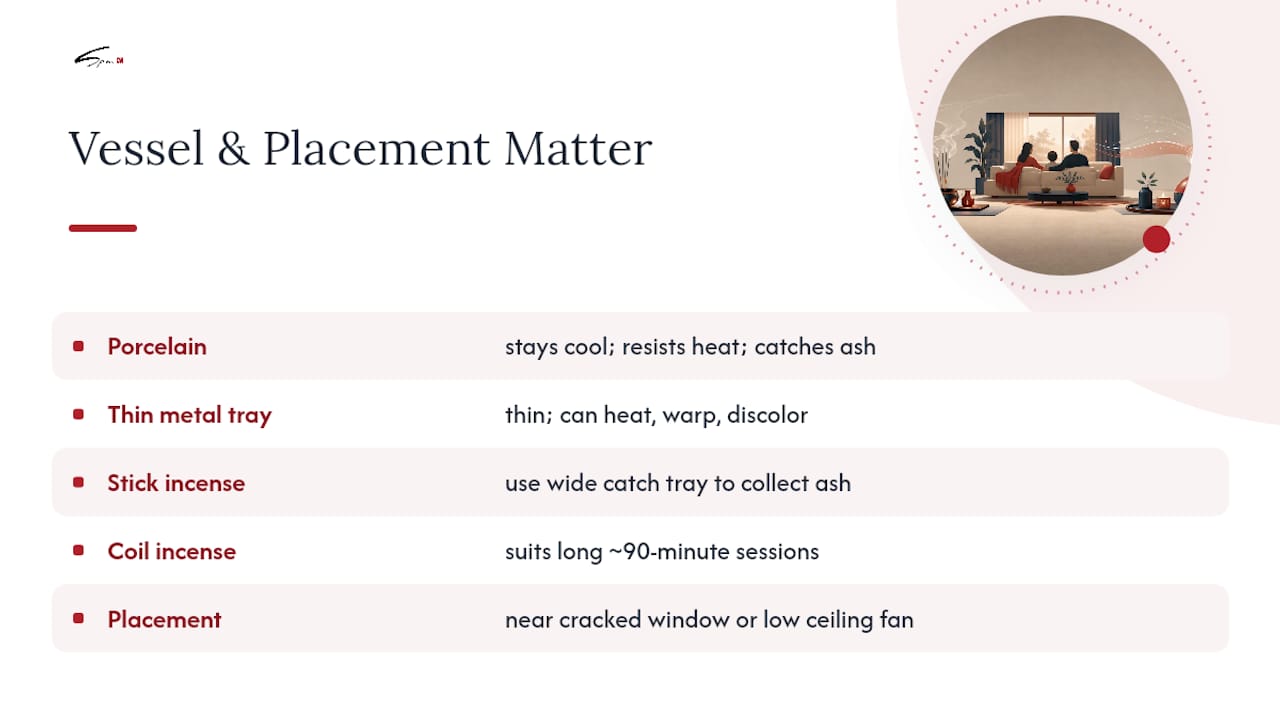
Most guides talk about scent method and skip the container entirely, which misses half the picture. A well-made incense burner does real safety work: it catches falling ash before it hits fabric or wood, resists the heat of a slow-burning ember, and keeps a lit stick upright instead of tipping toward a curtain. Porcelain performs that job better than the thin metal trays that come free with most incense packs, since it stays cool to the touch along the base and won’t warp or discolor from repeated heat exposure.
Placement matters too. Set a burner where air moves gently past it, near a cracked window or in a room with a ceiling fan on low, rather than in a sealed corner where smoke just pools. A handcrafted incense burner with a wide catch tray works well for stick incense, while a coil-style burner suits longer sessions where ash builds up gradually over ninety minutes. Pairing a soft glaze finish with warm woody scents, or a brighter pattern with citrus or floral incense, turns a functional object into part of the room’s design rather than an afterthought sitting on a shelf.
— Alan
Bring Ritual and Safety Together With Handcrafted Porcelain
Handcrafted porcelain incense burners can make the everyday act of lighting incense feel less like a fire hazard and more like a considered part of your room. Well-made burners crafted using traditional porcelain techniques are built to hold ash safely and stay cool where it matters, so you get the ritual of incense without babysitting a wobbly metal dish.

If you already lean toward incense for meditation or evening wind-down, a fisherman-style incense burner gives you a stable, decorative catch for ash while the porcelain finish adds real character to a shelf or side table. Browse the full collection on the Myspinshop homepage to find a piece that matches your space, then pick a burner that fits your routine and start your next session with a vessel built to hold up to it.
Sources
FAQ
Should I Get Incense or a Diffuser?
Get incense for short, intentional scent moments like meditation or a quick refresh, and a diffuser for continuous, adjustable background fragrance throughout the day. If anyone at home has breathing sensitivities, a diffuser is the safer everyday default.
Is Incense Bad for Your Lungs?
Yes, in meaningful amounts. Incense combustion releases fine particulate matter and volatile organic compounds that can irritate airways and aggravate existing lung conditions, according to the American Lung Association, so ventilation and shorter sessions matter.
Are Diffusers Safe for Your Lungs?
Diffusers avoid the combustion byproducts that make incense smoke risky, but essential oils are still volatile compounds that can irritate sensitive people in high concentrations. Regular cleaning also matters, since a neglected water reservoir can disperse mold or bacteria along with the mist.
Does Incense Purify the Air?
No. Incense adds particulate matter and combustion byproducts to indoor air rather than removing anything, so it should be treated as a scenting method, not an air-cleaning one.
Is Burning Incense Discouraged in the Bible?
The Bible references incense as part of ancient worship practices rather than prohibiting it, and interpretations vary widely by denomination and context. This is a matter of religious tradition and personal belief, not something a home-scenting comparison can settle.